


Dow White Paper Compares Silicone and Thermoplastic Lens Clusters
August 2, 2026
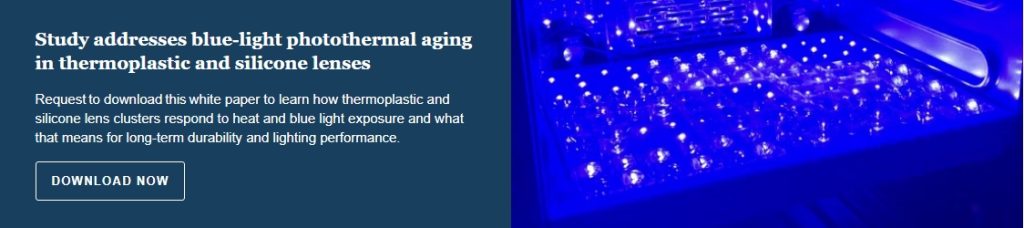
Dow has published a new white paper, “Blue Light Photothermal Aging of Thermoplastic and Silicone Lens Clusters,” that provides valuable insights for luminaire designers, optical engineers, and LED module manufacturers seeking to improve long-term reliability and performance. The study compares commercially available silicone and thermoplastic optics under conditions of heat and blue-light irradiance.
Testing showed that silicone optics maintained stability under high photothermal loads, while the thermoplastic optics were prone to discoloration, and, in some cases, catastrophic thermal runaway, an uncontrollable self-heating process that can result in device failure.
Key Findings from Dow’s Study
Testing revealed a consistent pattern among thermoplastic optics made from polycarbonate (PC), PMMA, and HT-PMMA. Although the threshold for catastrophic failure varied by material type, many of the tested thermoplastic lens clusters showed discoloration. In several cases, catastrophic failure occurred even when lumen maintenance appeared stable, making long-term degradation difficult to predict.
By contrast, the silicone lens clusters showed negligible changes in yellowness index (YI) and no signs of runaway degradation or catastrophic failure across the irradiance levels evaluated. The results reinforce silicone’s reputation for maintaining optical performance under demanding operating conditions.
For luminaire manufacturers, silicone’s resistance to photothermal degradation can help improve product reliability, extend service life, reduce maintenance concerns, and provide greater freedom when designing next-generation lighting systems.

